

Introduction
Claiming personal expenses as business expenses is one of the most common yet underestimated compliance risks faced by business owners, professionals, freelancers, and small enterprises. In most cases, this practice does not stem from deliberate tax evasion but from weak financial discipline, lack of awareness, informal bookkeeping, or the misconception that expenses paid from a business account automatically qualify as business deductions.
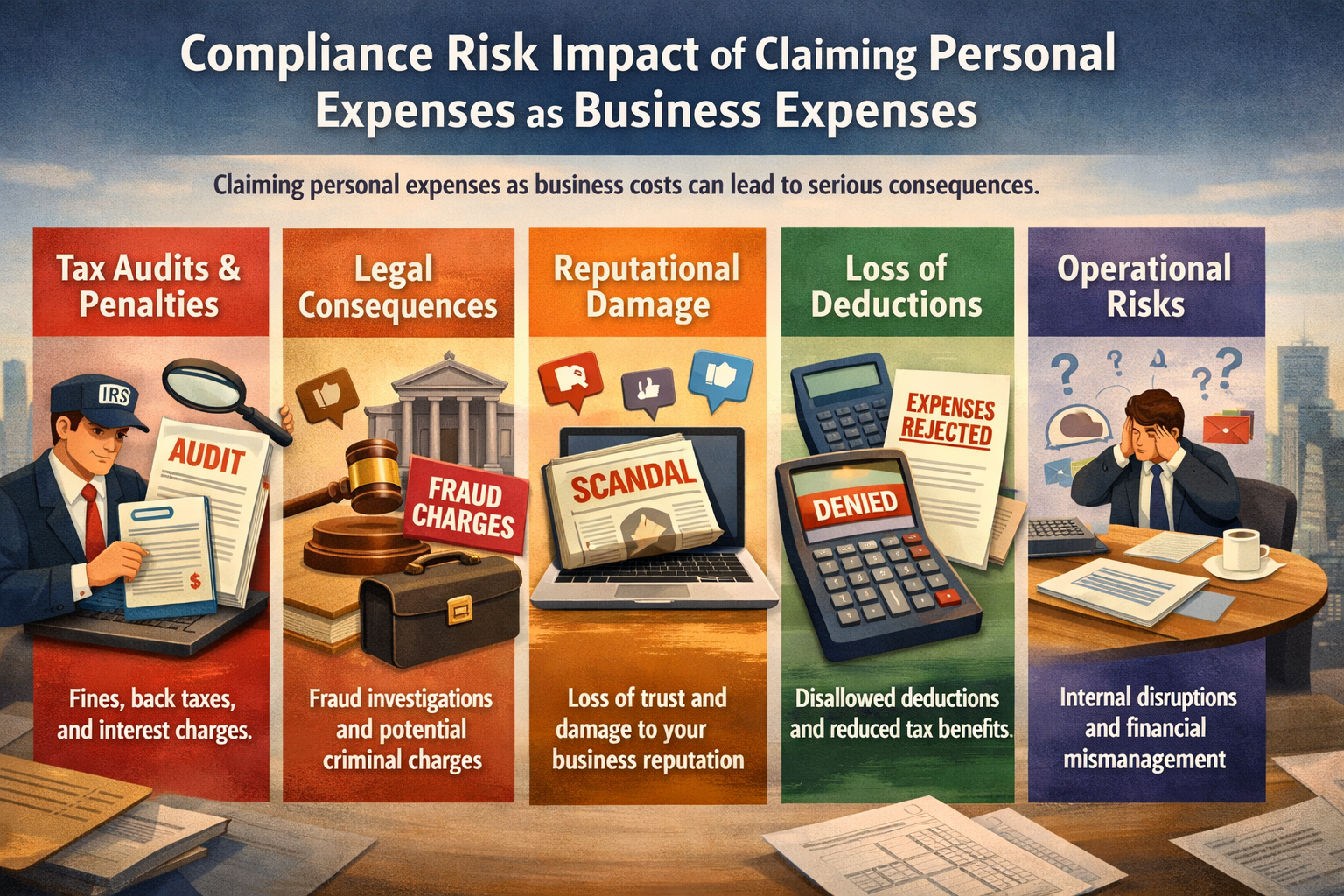
While such claims may offer minor short-term tax relief, they expose taxpayers to significant long-term consequences, including disallowance of expenses, additional tax liability, interest, penalties, scrutiny, loss of credibility, and in some cases, litigation. In today’s tax environment—characterised by digitisation, data analytics, faceless assessments, and extensive third-party reporting—the distinction between personal and business expenditure is increasingly transparent. Practices that once went unnoticed are now routinely flagged.
What Constitutes a Business Expense?
Under the Income Tax Act, only those expenses that are incurred wholly and exclusively for the purposes of business or profession are allowable as deductions. This principle is fundamental and leaves little scope for interpretation.
For an expense to qualify, it must be incurred during the relevant year, directly relate to business activity, and not be personal, capital, or prohibited in nature. Personal expenses fail this test by definition. Merely paying an expense from the business bank account or recording it in the books does not alter its character. Tax law evaluates the nature and purpose of the expenditure, not the source of payment.
Why Personal Expenses Enter Business Accounts
Despite clear legal provisions, personal expenses frequently find their way into business books, particularly in small or closely held businesses. Common reasons include lack of accounting knowledge, absence of structured bookkeeping, cash flow pressures, informal business setups, and use of common bank accounts, credit cards, vehicles, or premises for both personal and business purposes.
What begins as an occasional adjustment often becomes habitual. Over time, this casual approach turns into a systemic compliance risk.
Commonly Misclassified Personal Expenses
Personal expenses are often disguised under routine accounting heads, making detection possible only upon scrutiny. Typical examples include household groceries recorded as office expenses, personal mobile or internet bills claimed as business costs, family travel booked as business travel, personal vehicle expenses recorded as logistics, home utility bills shown as office expenses, and personal medical, insurance, or education expenses routed through business accounts.
Even expenses such as clothing, dining, entertainment, or gifts—unless directly and exclusively linked to business—are frequently misclassified. While individual amounts may appear insignificant, their cumulative effect distorts financial statements and tax computations.
Tax and Compliance Consequences
The most immediate consequence of claiming personal expenses as business expenses is disallowance during assessment, resulting in higher taxable income and additional tax liability. Importantly, disallowance does not require proof of intent. Even genuine mistakes can lead to additions if statutory conditions are not met.
Disallowances are typically accompanied by interest calculated from the original due date, significantly increasing the total demand. In cases of repeated or unjustified claims, tax authorities may also initiate penalty proceedings for under-reporting or furnishing inaccurate particulars. Penalties often exceed the tax initially saved, making the practice financially counter-productive.
Improper expense claims also increase the likelihood of scrutiny selection. Modern assessment systems rely on data analytics and pattern recognition, and once scrutiny is initiated, the scope often expands to detailed examination of books, bank statements, and even prior years.
Impact on Financial Statements and Business Growth
Beyond tax implications, personal expenses embedded in business accounts distort the true financial position of the enterprise. Artificially suppressed profits lead to misleading performance assessment, poor business decisions, and inaccurate valuations.
Banks and financial institutions rely heavily on financial statements and tax returns to assess creditworthiness. Lower reported profits may result in reduced loan eligibility, higher interest rates, or rejection of funding proposals. Ironically, businesses harm their own growth prospects in pursuit of marginal short-term tax savings.
Prevention and Corrective Measures
The most effective safeguard is strict separation of personal and business finances. This includes maintaining separate bank accounts and credit cards, implementing clear expense policies, and ensuring disciplined bookkeeping. Mixed-use expenses should be reasonably allocated and properly documented.
Where past errors exist, corrective action should be taken promptly. Options include revising returns where permissible, improving accounting practices prospectively, and making voluntary disclosures when required. Proactive correction is always viewed more favourably than defensive explanations.
Conclusion
Claiming personal expenses as business expenses is a silent but serious compliance risk that gradually erodes tax safety, financial integrity, and professional credibility. In an era of technology-driven assessments and data visibility, informal practices no longer remain invisible.
True tax efficiency lies not in aggressive or casual claims, but in compliant, transparent, and sustainable financial practices, supported by disciplined documentation and professional guidance.