

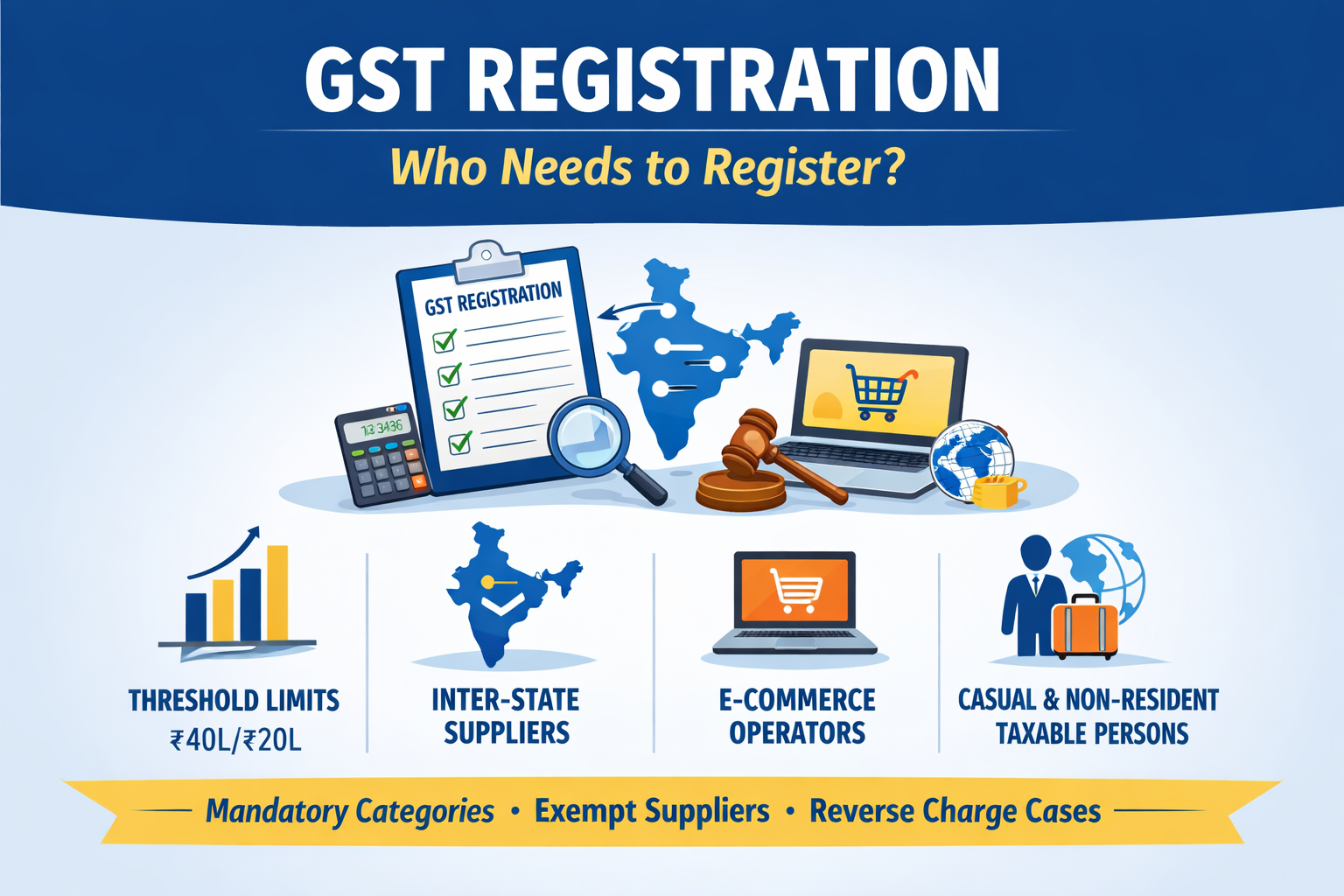
Introduction: Why GST Registration Still Confuses Businesses
Despite years of GST implementation, registration under GST continues to be one of the most misunderstood compliance areas. The confusion does not arise because the law is vague—but because its practical application is layered with conditions, exceptions, and overrides.
Some common reasons include:
- Multiple turnover thresholds
- Mandatory registration categories overriding limits
- Industry-specific exemptions
- Frequent amendments and notifications
- Interaction with income tax, TDS, e-commerce, exports, and cross-border services
For professionals, GST registration is not a procedural formality. A wrong decision can impact:
- Tax cost and pricing
- Input Tax Credit (ITC) eligibility
- Cash flows
- Departmental scrutiny and litigation exposure
This guide provides a section-wise, notification-aligned, and practical understanding of who is required to register under GST—backed by professional insights.
Statutory Framework Governing GST Registration
GST registration provisions are primarily governed by:
- Section 22 – Persons liable for registration
- Section 23 – Persons not liable for registration
- Section 24 – Compulsory registration (overriding thresholds)
- Section 25 – Procedure for registration
- Relevant notifications, circulars, and FAQs
Professional Tip: These sections must be read together, not in isolation. Most errors arise when Section 24 is overlooked.
Who Is a “Person” Under GST?
Before determining liability, it is crucial to identify who qualifies as a person under GST.
As per Section 2(84), “person” includes:
- Individual / Proprietorship
- HUF
- Company
- Firm / LLP
- AOP / BOI
- Trust
- Government / Local Authority
- Artificial juridical person
Professional Insight
GST liability is entity-specific, not merely PAN-based.
One PAN can have multiple GST registrations across States or business verticals.
Threshold-Based Registration – Section 22
Understanding Aggregate Turnover
A person becomes liable for registration when aggregate turnover exceeds the prescribed threshold in a financial year.
Aggregate turnover includes:
- Taxable supplies
- Exempt supplies
- Zero-rated supplies (exports)
- Inter-state supplies
- Supplies made on own account or on behalf of principals
Excludes:
- GST components (CGST, SGST, IGST, Cess)
- Inward supplies under reverse charge
👉 Computed PAN-wise across India, not State-wise.
Current Threshold Limits
Nature of SupplyThresholdGoods – Normal States₹40 lakhGoods – Special Category States₹20 lakhServices – All States₹20 lakhServices – Special Category States₹10 lakh
Professional Warning:
Errors commonly occur due to:
- Ignoring exempt turnover
- Treating multiple businesses under one PAN as separate
- Misclassifying inter-state supplies
Goods vs Services: Why Classification Matters
Thresholds differ for goods and services. For mixed supplies, consider:
- Contract terms
- Principal supply
- Billing structure
Example:
A software consultant selling licenses along with implementation may still qualify as a service provider, depending on contract dominance.
Persons Not Liable for Registration – Section 23
Certain persons are exempt from registration, regardless of turnover.
Agriculturists
- Supply of produce from cultivation of land
- Applies only to primary agricultural produce
- Not applicable to processing, trading, or branding
Exclusive Exempt Supply Providers
Registration not required if only exempt supplies are made.
Examples:
- Healthcare services
- Educational institutions (specified services)
- Unbranded agricultural produce
⚠️ Once any taxable supply is made, Section 23 relief ceases.
Mandatory Registration – Section 24 (Most Litigated Area)
Section 24 overrides threshold limits. If applicable, registration becomes compulsory.
Key Categories Include:
1. Inter-State Taxable Suppliers
- Mandatory registration, regardless of turnover
- Exception available for service providers up to threshold
2. Casual Taxable Persons (CTP)
- Temporary business activities
- No fixed place of business
- Requires advance tax payment
3. Non-Resident Taxable Persons (NRTP)
- Foreign entities supplying in India
- Mandatory temporary registration
4. E-Commerce Operators (ECOs)
- Mandatory registration irrespective of turnover
5. Suppliers Through E-Commerce Platforms
- Goods suppliers: mandatory registration
- Certain service providers: threshold exemption available
6. Reverse Charge Liability Cases
- Advocates
- GTA (specified cases)
- Notified services
7. Input Service Distributors (ISD)
- Head office distributing ITC
8. TDS / TCS Deductors
- Government bodies, PSUs, notified entities
9. Agents of Taxable Persons
- Acting on behalf of principal
Special Situations Requiring Careful Analysis
- Multiple States: Separate registration in each State
- Project / Branch Offices: Depends on control and supply nature
- Transfer of Business: New registration required
- Change in Constitution: Fresh registration mandatory
GST Registration for Professionals
CAs, Lawyers, Consultants
- Services category
- Threshold: ₹20 lakh
- Inter-state services allowed up to threshold
- Legal services subject to RCM
Freelancers
- Export of services included in turnover
- Foreign clients ≠ registration exemption
Exporters & Zero-Rated Supplies
- Registration mandatory to claim refunds
- LUT/Bond compliance
- Strategic choice between IGST payment or LUT
Consequences of Non-Registration
Failure to register when liable can result in:
- Tax demand with interest @ 18%
- Penalty up to 100% of tax
- Denial of ITC to customers
- Prolonged litigation
Professional Reality:
Most GST notices arise from incorrect registration decisions, not intentional evasion.
Strategic Considerations Before Advising Registration
Evaluate:
- ITC benefit vs compliance cost
- Customer profile (B2B / B2C)
- Pricing impact
- Cash flow strain
- Risk appetite
Quick Professional Checklist
✔ Nature of supply
✔ Turnover computation
✔ State-wise operations
✔ Section 24 triggers
✔ RCM exposure
✔ E-commerce involvement
✔ Export activities
✔ Scalability plans
Conclusion: GST Registration Is a Strategic Tax Decision
GST registration is not merely about crossing a turnover limit. It is a strategic decision that directly affects compliance burden, profitability, and future litigation exposure.
For professionals, accurate GST registration advice is one of the most critical value-adding services—and one of the most litigated if done incorrectly.