

Introduction
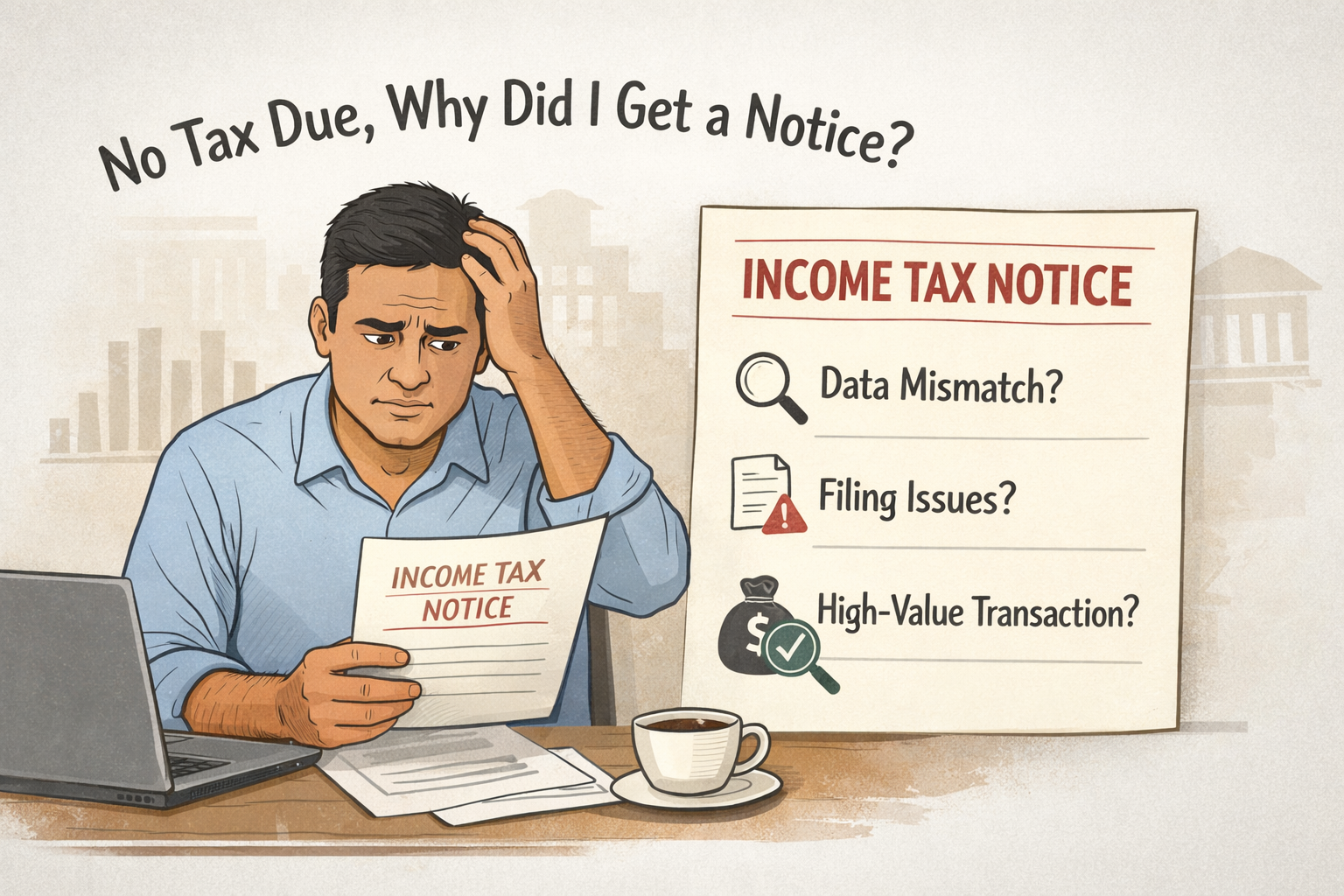
One of the most common reactions among taxpayers in India upon receiving an Income Tax notice is shock, confusion, and often anxiety—especially when the taxpayer is confident that no tax is payable. The immediate question that arises is: “Why has the Income Tax Department issued a notice to me when I have no tax liability?”
This concern, although understandable, is largely based on a misunderstanding of how the income tax administration system functions today. An Income Tax notice does not necessarily mean a tax demand, nor does it automatically imply concealment, evasion, or wrongdoing. In many cases, notices are issued due to information mismatches, procedural lapses, reporting gaps, or system-generated alerts—even when the final tax payable is nil.
With increasing digitisation, advanced data analytics, and extensive third-party reporting, the Income Tax Department now operates as an information-driven authority. Banks, employers, mutual funds, registrars, GST systems, property authorities, and other reporting entities continuously share data with the department. Consequently, most notices are triggered by automated risk assessment systems rather than manual suspicion.
This article explains why a taxpayer may receive an Income Tax notice despite having no tax liability, the legal and procedural reasons behind such notices, and how such communications should be approached calmly and strategically.
Understanding the Purpose of an Income Tax Notice
An Income Tax notice is a formal communication seeking clarification, correction, verification, or compliance. Its purpose depends on the specific section under which it is issued.
Broadly, notices may be issued to:
- Intimate the taxpayer about return processing results
- Seek explanations or supporting documents
- Highlight discrepancies or mismatches
- Rectify apparent errors
- Initiate assessment or reassessment proceedings
- Ensure procedural and reporting compliance
Importantly, a notice does not automatically lead to additional tax liability. In many cases, the matter concludes once the taxpayer provides the required explanation or rectifies a procedural issue.
Myth: “If No Tax Is Payable, No Notice Can Be Issued”
A widespread misconception among taxpayers is that notices are issued only when tax is due. This assumption is incorrect.
The Income-tax Act does not restrict the issuance of notices to cases involving tax demand. Notices can be issued for verification, confirmation, or information-gathering purposes—even where the ultimate tax payable is zero.
For instance, a taxpayer may:
- Have income below the basic exemption limit
- Have paid full tax through TDS or advance tax
- Have losses that offset taxable income
Yet, a notice may still be issued due to inconsistencies, non-disclosure, or procedural non-compliance.
Mismatch Between Reported Income and Departmental Data
One of the most common reasons for receiving a notice despite nil tax liability is data mismatch.
The Income Tax Department receives extensive third-party information, including:
- Bank interest and deposits
- Mutual fund investments and redemptions
- Share trading transactions
- Property purchases or sales
- Credit card spending
- TDS and TCS details
This information is reflected in the Annual Information Statement (AIS) and Taxpayer Information Summary (TIS). If the income disclosed in the return does not align with this data, the system flags the return for verification.
For example, if bank interest is reported by a bank but omitted from the return—even if total income remains below taxable limits—a notice may be issued seeking clarification. Such notices are aimed at data reconciliation, not tax evasion.
Non-Filing of Return Despite Nil Tax Liability
Many taxpayers assume that if income is below the exemption limit, filing a return is unnecessary. While this is partially correct, there are several situations where filing becomes mandatory regardless of tax liability.
Notices are commonly issued where:
- High-value transactions are reported but no return is filed
- TDS has been deducted and a refund is claimable
- The taxpayer meets specific reporting criteria under law
- The department seeks confirmation of income details
For example, investments made from savings, loans, or gifts may not generate taxable income, but the transaction itself is reported to the department. Non-filing in such cases often results in a notice seeking explanation.
Defective Returns and Procedural Errors
Notices are also issued when returns are found to be technically defective.
Common defects include:
- Selection of an incorrect ITR form
- Missing mandatory schedules
- Incomplete income or deduction details
- Mismatch in balance sheet or profit figures
- Invalid or incomplete audit information
Such notices are procedural in nature and can arise even when tax payable is zero. Failure to rectify defects within the prescribed time may result in the return being treated as invalid, leading to further complications.
Refund Claims and Verification Notices
Taxpayers often receive notices while claiming refunds, even when no tax is payable.
This may occur due to:
- TDS mismatch
- Incorrect bank account details
- Discrepancies between Form 26AS and ITR
- Refund claims disproportionate to declared income
These notices are preventive, intended to verify the accuracy of refund claims before releasing funds, rather than to raise tax demands.
High-Value Transactions Triggering System Alerts
The Income Tax Department closely monitors high-value transactions, irrespective of tax liability.
Such transactions include:
- Large cash deposits
- Substantial mutual fund investments
- Property purchases or sales
- High credit card spending
- Significant share market activity
Even when funded through exempt income, loans, or past savings, these transactions may trigger notices seeking clarification of the source of funds. The focus here is on disclosure and traceability, not merely on tax payable.
Exempt Income Not Properly Disclosed
Although certain incomes are exempt from tax, they still require proper disclosure in the return.
Common examples include:
- Agricultural income
- Interest from tax-free bonds
- Certain allowances
- Gifts received from specified relatives
Failure to disclose exempt income may result in notices seeking verification, despite there being no tax impact.
Loss Carry Forward and Compliance Issues
The carry forward of losses is subject to strict procedural compliance.
Notices may be issued where:
- Loss returns are filed after the due date
- Loss figures do not match previous years
- Set-off claims are inconsistent
Even though the net tax payable may be nil, non-compliance with filing requirements can still attract departmental communication.
Reassessment Notices with Nil Tax Outcome
In some cases, reassessment notices are issued based on information suggesting possible escapement of income. Upon verification and explanation, it may be established that no taxable income has actually escaped assessment.
Such notices reflect preventive oversight, not a confirmed tax liability.
Faceless and Automated Assessments
With the introduction of faceless assessment systems, notices are increasingly system-generated.
Selection may be based on:
- Risk parameters
- Data analytics
- Artificial intelligence models
- Random sampling
As a result, even compliant taxpayers may occasionally receive notices without any manual intervention.
Psychological Impact and Misinterpretation
Income Tax notices often cause anxiety due to their association with penalties and prosecution. In reality, most notices are routine compliance checks.
Ignoring notices or reacting emotionally often escalates matters unnecessarily. A timely, factual, and professional response usually resolves the issue efficiently.
How Taxpayers Should Respond
The correct approach includes:
- Carefully reading and understanding the notice
- Identifying the relevant section and objective
- Reviewing AIS, TIS, and the filed return
- Collecting supporting documents
- Submitting a clear and factual response within time
In many cases, this concludes the matter without any tax demand.
Role of Tax Professionals
Engaging a tax professional ensures:
- Accurate interpretation of notices
- Legally sound and well-drafted replies
- Compliance with statutory timelines
- Reduced risk of unnecessary litigation
Professional assistance helps ensure that explanations are comprehensive, consistent, and defensible.
Conclusion
Receiving an Income Tax notice despite having no tax liability is not unusual in today’s data-driven tax environment. Such notices are typically triggered by information mismatches, procedural lapses, or automated verification mechanisms—not allegations of wrongdoing.
Understanding the nature and intent of these notices empowers taxpayers to respond confidently and effectively. Transparency, timely compliance, and proper communication remain the most effective tools when dealing with tax authorities.
Rather than viewing notices as threats, taxpayers should see them as part of a structured compliance framework designed to uphold the integrity of the tax system.